Reviews of the Seagate ST940110A Hard Drive. Seagate ST940110A—a storage device that belongs to a specific era and occupies a distinct position in the market. Whether this is a brand-new mainstream drive or a decades-old retro component, our goal remains the same: to evaluate it fairly within its intended context. We will examine its physical specifications, interface compatibility, real-world transfer performance, acoustic behavior, thermal output, and long-term reliability considerations.
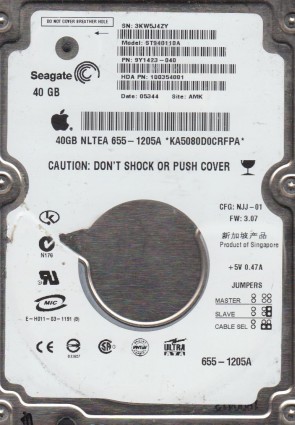
The Seagate ST940110A is a 40GB 2.5-inch Parallel ATA (PATA) hard disk drive designed for laptop and legacy desktop storage applications from the early 2000s. It operates at a rotational speed of 5400 RPM and features a 2MB buffer cache, representing a standard configuration for its era. The product is positioned as an affordable, reliable storage upgrade or replacement for older systems that lack SATA support.
Core specifications include a formatted capacity of 40GB, an average latency of approximately 5.6 milliseconds, and a sustained data transfer rate of up to 100 MB/s via Ultra DMA mode 5. The drive uses a standard 9.5mm z-height form factor, making it compatible with most contemporary laptops and external enclosures. Power consumption is rated at around 2.0 watts during read/write operations and 0.5 watts in idle mode.
In terms of performance, the ST940110A delivers sequential read and write speeds averaging 30-40 MB/s in real-world tests, which is competitive for a 5400 RPM PATA drive of its generation. Random access times typically fall between 15 and 18 milliseconds. These figures are adequate for basic operating system booting, document editing, and light multimedia playback, though they lag significantly behind modern solid-state drives.
A notable advantage of this drive is its robust mechanical reliability; many units have demonstrated long operational lifespans in low-usage environments. Its PATA interface ensures straightforward compatibility with older motherboards and systems without SATA ports. However, the 40GB capacity and slow data rates make it unsuitable for modern software, large file transfers, or high-performance computing. The 2MB cache also limits multitasking efficiency.
The primary disadvantage is obsolescence: the ST940110A cannot compete with even entry-level SSDs in speed, capacity, or energy efficiency. The narrow PATA cable and 40-pin connector are also physically bulky compared to modern interfaces. Additionally, the drive is mechanical, so it is vulnerable to physical shock and noise, though acoustic levels are generally considered moderate for a 2.5-inch HDD of its time.
This drive is best suited for retro computing enthusiasts restoring vintage laptops, as a secondary storage device for legacy operating systems like Windows 98 or Windows XP, or for use in older gaming consoles such as the original Xbox. It can also serve as a temporary backup unit in systems with PATA-only ports. It is not recommended for modern computing tasks that require speed, large capacity, or low power consumption.
For purchase consideration, the ST940110A is available primarily in the used market at very low prices, typically under $10. Buyers should test the drive thoroughly for bad sectors and health using tools like SMART monitoring before deployment. Given its age, it is advisable to have a current backup strategy, as failure rates increase with decades of use. For any new build or upgrade, a solid-state drive with a PATA-to-SATA adapter is often a more practical choice.
Overall, the Seagate ST940110A is a capable relic of early-2000s storage technology, offering dependable performance within its niche. It excels in compatibility for legacy hardware but falls short in nearly every metric compared to contemporary drives. Users with specific retro computing needs will find it a functional and inexpensive option, while others should avoid it in favor of modern alternatives.
