Reviews of the Hitachi IC35L120AVVA07 Hard Drive. Hitachi IC35L120AVVA07—a storage device that belongs to a specific era and occupies a distinct position in the market. Whether this is a brand-new mainstream drive or a decades-old retro component, our goal remains the same: to evaluate it fairly within its intended context. We will examine its physical specifications, interface compatibility, real-world transfer performance, acoustic behavior, thermal output, and long-term reliability considerations.
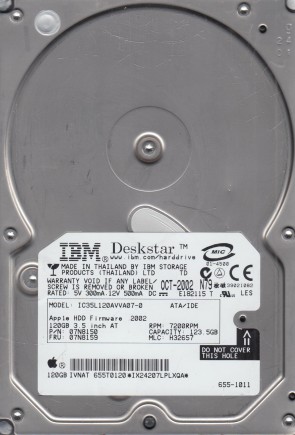
The Hitachi IC35L120AVVA07 is a 3.5-inch internal hard disk drive from the Deskstar 7K250 series, positioned as a reliable storage solution for desktop computers and entry-level servers during its prime era. It offers a capacity of 120GB, which was considered standard for mainstream users seeking a balance between storage space and cost. This model is designed primarily for use as a primary boot drive or for storing applications and personal files in systems that do not require high-speed SSD performance or massive capacity.
Core specifications include a spindle speed of 7,200 RPM, an 8MB cache buffer, and an Ultra ATA-100 (IDE) interface. The drive features a 2.5ms average seek time and a sustained transfer rate of up to 55 MB/s. Its form factor is standard 3.5-inch, with dimensions of 26.1mm x 101.6mm x 146.99mm and a weight of approximately 640 grams. These specs were typical for high-performance consumer hard drives in the mid-2000s, emphasizing consistent throughput for sequential workloads.
In terms of performance, the IC35L120AVVA07 delivers reliable read and write speeds for its interface, with burst transfer rates reaching 100 MB/s under ideal conditions. Real-world benchmarks from that period show sequential read speeds around 50-55 MB/s and write speeds slightly lower, which is adequate for booting operating systems like Windows XP or storing game libraries of the era. Random access times are competitive at roughly 13-15ms, but the drive struggles with random I/O due to the mechanical nature and older interface, making it slower for multitasking or heavy database workloads.
Advantages of this drive include its proven durability and low power consumption, typically drawing 5.5W during read/write and 1.2W in idle mode. The Deskstar 7K250 family was known for its quiet operation thanks to Fluid Dynamic Bearing (FDB) motors, producing only about 2.8 to 3.2 bel in idle. Its price-per-gigabyte ratio at launch was favorable for budget-conscious builders, and it offered a 3-year warranty, indicating reasonable manufacturing confidence. The drive also integrates shock protection technology to handle minor bumps during operation.
Drawbacks are significant by modern standards. The ATA-100 interface limits real-world throughput to under 60 MB/s, which is dramatically slower than any SSD or modern SATA III HDD. Capacity is also very modest today, likely insufficient for even basic system backups or media libraries. Additionally, as a vintage component, finding a unit in usable condition is increasingly difficult, and modern motherboards lack IDE connectors without adapters. Power consumption and heat output, while low for its time, are higher than current 2.5-inch drives.
The ideal use case for the Hitachi IC35L120AVVA07 is as a secondary or tertiary drive in retro computing projects, such as reviving an old Pentium 4 or Athlon XP system for period games, software testing, or archival purposes. It can also function as a low-cost storage option in legacy industrial PCs that still rely on parallel ATA connections. Enthusiasts building era-appropriate workstations may appreciate its authentic performance characteristics for benchmarking or preserving original computing experiences. For modern systems, it is not recommended as a primary drive.
Buying this drive today should be approached with caution. Used or refurbished units are the only options, with prices varying from $10 to $30 depending on condition and seller. Always verify the SMART data to check for reallocated sectors, power-on hours, and pending errors. It is best suited for collectors or hobbyists with compatible hardware, as purchasing for daily use in a contemporary PC is impractical. For general storage, modern 2.5-inch SSDs or SATA HDDs with adapter cards offer far superior speed, capacity, and reliability at similar price points.
In summary, the Hitachi IC35L120AVVA07 is a competent but obsolete component that performs adequately within its historical context. It delivers steady sequential throughput, low noise, and acceptable power efficiency for its generation, but falls short in modern scenarios due to interface bottlenecks, limited capacity, and aging mechanical components. Buyers should treat it as a niche item for vintage system restoration rather than a practical storage upgrade, ensuring they pair it with appropriate controllers and backup practices to mitigate data loss risks.