Reviews of the Toshiba MK8025GAL Hard Drive. Toshiba MK8025GAL—a storage device that belongs to a specific era and occupies a distinct position in the market. Whether this is a brand-new mainstream drive or a decades-old retro component, our goal remains the same: to evaluate it fairly within its intended context. We will examine its physical specifications, interface compatibility, real-world transfer performance, acoustic behavior, thermal output, and long-term reliability considerations.
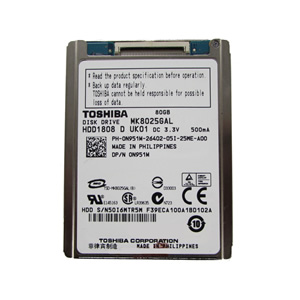
The Toshiba MK8025GAL is a 2.5-inch, 80GB PATA (Parallel ATA) hard disk drive designed primarily for legacy laptops, ultraportable devices, and embedded systems from the mid-2000s era. It operates at a spindle speed of 4200 RPM and features a 2MB buffer, positioning it as a budget-friendly storage solution focused on low power consumption and quiet operation rather than high performance. This drive is compatible with older notebooks that require a 9.5mm z-height and a standard IDE interface.
Core specifications include a formatted capacity of 80GB, an average seek time of approximately 12 milliseconds, and a data transfer rate of up to 100 MB/s over the Ultra ATA-100 interface. The drive consumes roughly 1.5 watts during read/write operations and drops to below 0.5 watts in idle or sleep modes, making it suitable for battery-sensitive portable environments. Its physical dimensions are 70mm x 100mm x 9.5mm, and it weighs about 99 grams.
In terms of performance, the MK8025GAL delivers sequential read and write speeds typically ranging between 25 MB/s and 40 MB/s, which is modest by modern standards but adequate for basic operating system tasks and document handling on older hardware. Random access performance is limited due to the low RPM and small cache, resulting in noticeable latency when loading multiple small files or launching applications. The drive operates with an acoustic noise level around 2.4 decibels, ensuring near-silent operation in most use cases.
Key advantages of this drive include its low power draw, which extends battery life in aging laptops, and its high reliability for a platter-based mechanism of its generation, with a stated mean time between failures (MTBF) of 300,000 hours. It also generates minimal heat, reducing thermal stress in compact enclosures. However, significant drawbacks include very slow data transfer speeds compared to modern SSDs or even later 5400 RPM hard drives, a limited 80GB storage capacity unsuitable for media-heavy workloads, and the obsolete PATA interface that prevents use in newer systems without an adapter.
The Toshiba MK8025GAL is best suited for users maintaining vintage laptops, industrial control systems, or retro gaming machines that require an original-spec replacement drive. It also serves as a functional option for low-budget data archival where speed is not critical. Conversely, it is not recommended for daily-use computers, modern operating systems like Windows 10 or macOS, or any application demanding fast boot times or large file transfers due to its age and technical limitations.
For purchase decisions, buyers should verify that their device supports PATA (IDE) connectors and a 9.5mm drive bay. Given the drive’s vintage nature, sourcing it used or refurbished is common, and testing for bad sectors immediately upon acquisition is advised. For most users, however, investing in a compatible PATA-to-SSD adapter and a modern 2.5-inch SATA SSD will provide vastly superior performance, reliability, and capacity at a similar price point, making the MK8025GAL a niche choice reserved strictly for hardware restoration projects.