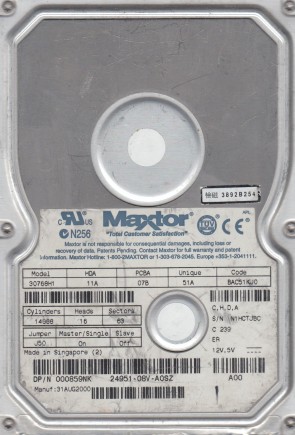
Maxtor 30768H1 3.5″ hard drive with a storage capacity of 7.6 GB and featuring an IDE interface. Maxtor 30768H1 DiamondMax VL 30 7.6 GB 3.5″ Internal Hard Drive IDE Ultra ATA/100 5400 RPM 512 KB Buffer.
All information about the Maxtor 30768H1 hard disk drive: technical parameters, failure symptoms, frequently asked questions, reviews, HDD repair and data recovery.

Maxtor 30768H1 Technical Details:
Note: The Maxtor 30768H1 is part of the DiamondMax VL 30 (Value Line) series, released around 2000-2001. This series was designed as an entry-level storage solution for budget-conscious systems and consumer electronics applications, offering capacities up to 30 GB. The “VL” stands for “Value Line”. Other models in this series include 33073H4 (30 GB), 32305H3 (23 GB), and 31536H2 (15 GB).
Maxtor 30768H1 Hard Drives:
- 30768H1 – 7.6 GB IDE 3.5″ Hard Drive, DiamondMax VL 30 series
- PCB Part Numbers: 1465, 1480
- PCB Controller: Known as “n256”
- Capacity in LBA: 15,007,104 sectors (7,683 MB usable)
Maxtor 30768H1 Failure Symptoms:
Electrical Failure Symptoms:
- Drive is powered, but shows no sign of function;
- Disk knocking as the motor fails to spin;
- Clicking sound as the heads search or initialize.
Mechanical Failure Symptoms:
- Extremely loud noise – “like a jet engine taking off” – a common and distinctive symptom of this drive, typically indicating spindle motor or bearing failure;
- Clicking, grinding sounds;
- Completely quiet due to “motor freeze”;
- Very slow write speeds (copy tasks that should take minutes take hours).
Logical Failure Examples:
- Accidental deletion, accidental format, file corruption, software bugs;
- File system corruption, viruses and malware;
- DMA-related issues causing kernel panics in Linux systems.
Firmware Failure Symptoms:
- Drive powers up but is not recognised by the computer;
- Drive powers up but is recognised wrongly, sometimes with nonsensical characters;
- Drive freezes during booting up.
Bad Platter Area Symptoms:
- Hard disk still accessible but appears to “hang” or be “sluggish”;
- Constant Cyclic Redundancy Check (CRC) errors;
- Unable to access folders or files which could be seen.
Complex Failure Model
(A combination of two or more of the above failure types)
Maxtor 30768H1 Data Recovery & HDD Repair:
When it comes to data recovery, one of the most common problems the Maxtor 30768H1 hard drive experiences is mechanical failure – particularly spindle motor/bearing failure causing extremely loud operational noise.
Symptom Analysis Based on User Reports:
ide=nodma boot option for temporary accessRepair & Data Recovery Options by Failure Type:
Comparison with Related Maxtor Models:
⚠️ Critical Note: The “jet engine” noise is a signature failure of the DiamondMax VL 30 series. If your 30768H1 makes this sound, back up your data immediately if the drive is still accessible. Continued operation may cause complete motor seizure and permanent data loss.
Frequently Asked Questions (FAQs):
Q: Is the Maxtor 30768H1 a 3.5″ or 2.5″ drive?
A: It is a 3.5-inch desktop hard drive.
Q: What is the capacity of the 30768H1?
A: 7.6 GB (approximately 7,680 MB). The LBA capacity is 15,007,104 sectors.
Q: What is the RPM and cache size?
A: 5400 RPM and 512 KB cache.
Q: What interface does the 30768H1 use?
A: IDE (PATA) with Ultra ATA/100 support.
Q: Why does my 30768H1 sound like a jet engine?
A: This is a common mechanical failure of the DiamondMax VL 30 series, specifically spindle motor bearing failure. The drive should be backed up immediately if still accessible, as continued use may lead to complete motor seizure.
Q: My drive is extremely slow when writing files. What’s wrong?
A: This is often related to motor aging or speed inconsistency. Users have reported that copying a “few minutes of work” takes hours. This is a sign of impending failure – back up your data and replace the drive.
Q: I’m getting DMA errors / kernel panics in Linux. How can I access my data?
A: Some Linux kernels have compatibility issues with ATA-66/ATA-100 on this drive. Try booting with the ide=nodma option to disable DMA and access the drive in PIO mode. Example: add ide=nodma to your kernel boot line in GRUB.
Q: How do I replace the PCB on a 30768H1?
A: You need a donor board with identical specifications:
– Model: 30768H1
– PCB part number: 1465 or 1480
– Controller: “n256”
Unlike some other drives, the 30768H1 does not have a separate ROM chip, so the donor board must be fully compatible.
Q: What are the other drives in the DiamondMax VL 30 series?
A: The series includes:
– 30768H1 (7.6 GB)
– 31536H2 (15 GB)
– 32305H3 (23 GB)
– 33073H4 (30 GB)
Q: Can the 30768H1 be used with a modern computer?
A: Not directly. You would need a USB-to-IDE adapter or an IDE-to-SATA bridge. Given its age (20+ years) and small capacity, its practical use is extremely limited – it may be useful for retro computing projects (Windows 95/98/NT/2000 builds).
Q: Is this drive worth buying today?
A: Generally no. This drive is over 20 years old and has known mechanical failure patterns (especially the “jet engine” bearing noise). It may be used for retro computing as a collector’s item, but do not use it to store any important data.
User Reviews & Summary:
Pros (for its time ~2000):
– Single-platter, single-head design for lower mechanical complexity
– 5400 RPM with 9.5ms seek time – competitive for entry-level drives at launch
– 500,000 hour MTBF rating
– Part of Maxtor’s popular DiamondMax line
Cons (by modern standards):
– 7.6 GB capacity is tiny by today’s standards
– IDE interface is completely obsolete
– Known “jet engine” bearing failure
– Very slow write speeds when failing
– DMA compatibility issues with some Linux kernels
– Spare parts are extremely difficult to source
Final Verdict:
The Maxtor 30768H1 is a 7.6 GB model from Maxtor’s DiamondMax VL 30 series, released around 2000-2001. While it was a decent entry-level drive in its time, it is now over 20 years old and has developed a notorious reputation for spindle motor bearing failure – the signature “jet engine” noise. If you still have a working 30768H1 today, it should only be used for retro computing projects as a collector’s item – never store irreplaceable data on it. For data recovery, DIY attempts beyond simple logical recovery have low success rates; professional recovery is strongly recommended for valuable data, especially if the drive is making unusual noises.