Reviews of the Maxtor 4G160J8 Hard Drive. Maxtor 4G160J8—a storage device that belongs to a specific era and occupies a distinct position in the market. Whether this is a brand-new mainstream drive or a decades-old retro component, our goal remains the same: to evaluate it fairly within its intended context. We will examine its physical specifications, interface compatibility, real-world transfer performance, acoustic behavior, thermal output, and long-term reliability considerations.
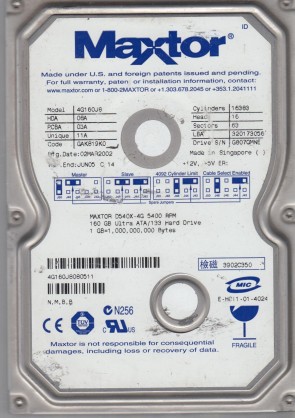
The Maxtor 4G160J8 is a legacy 3.5-inch Parallel ATA (PATA) hard disk drive designed for desktop computers from the mid-2000s. It offers a storage capacity of 160GB, which was considered substantial at the time of its release. This drive utilizes a spinning platter technology with a rotational speed of 7200 RPM and features an Ultra ATA/100 interface for data transfer.
Core specifications include a 2MB buffer cache, a seek time of approximately 9.0 milliseconds, and an internal data transfer rate that peaks around 60 MB/s. The drive operates on a standard 5V and 12V power supply, and its physical dimensions are standard for desktop drives of that era. It is not a solid-state drive and relies on mechanical components for read and write operations.
In terms of performance, the Maxtor 4G160J8 delivers adequate throughput for basic operating system tasks and file storage from the Windows XP and early Windows 7 era. Sequential read and write speeds average around 40-55 MB/s, which is typical for its interface and rotational speed. Random access times are slow by modern standards, leading to noticeable lag when loading multiple small files or booting an operating system.
A key advantage of this drive is its reliability for its age; many units have survived decades of use due to robust manufacturing. It is also extremely affordable in the second-hand market, often costing a few dollars. However, significant weaknesses include its low capacity, slow transfer rates compared to SATA or SSD drives, high power consumption, and audible mechanical noise during operation. It also produces considerable heat under load.
The drive performs adequately for sequential workloads, such as storing and playing large media files like video or music collections. It struggles with multitasking or heavy random I/O operations, such as running a modern operating system with multiple applications. The 2MB cache is a major bottleneck, especially for file fragmentation and write-heavy tasks.
Suitable use cases for the Maxtor 4G160J8 include use as a secondary storage drive in a retro computing setup, a data archival unit for non-critical files, or a component for repairing older computers. It is not recommended for any modern system requiring fast boot times, gaming, or server workloads. Enthusiasts building a period-correct Windows 98 or XP machine will find this drive a historically accurate choice.
For purchase, potential buyers should seek out tested units from reputable electronics recyclers or collectors. Avoid drives with high Power-On Hours (POH) or any reported reallocated sectors. Given its age, expect the drive to eventually fail due to mechanical wear. For most users, a modern solid-state drive with a PATA-to-SATA adapter provides vastly superior performance and reliability.
In summary, the Maxtor 4G160J8 is a vintage storage component that offers reasonable performance for its era. Its strengths lie in affordability and legacy compatibility, while its weaknesses are low speed, capacity, and high noise. It serves a niche purpose for retro computing and data archival, but is obsolete for general use.