Reviews of the Western Digital WD2500BEAS Hard Drive. Western Digital WD2500BEAS—a storage device that belongs to a specific era and occupies a distinct position in the market. Whether this is a brand-new mainstream drive or a decades-old retro component, our goal remains the same: to evaluate it fairly within its intended context. We will examine its physical specifications, interface compatibility, real-world transfer performance, acoustic behavior, thermal output, and long-term reliability considerations.
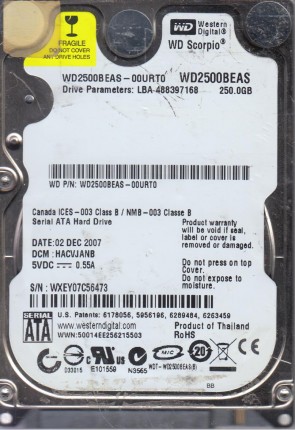
The Western Digital WD2500BEAS is a 2.5-inch, 250GB hard disk drive designed for mainstream laptop and portable storage applications. It utilizes a 5400 RPM spindle speed and a SATA 3.0 Gb/s interface, positioning it as a budget-friendly, reliable storage solution for users who prioritize capacity and power efficiency over extreme speed. This drive is often found in older notebooks and external enclosures where silent operation and low heat generation are valued.
Core specifications include a 250GB formatted capacity, 8MB of cache buffer, and a typical average seek time of 12.0 ms. The drive features a 2.5-inch form factor with a height of 9.5mm, making it compatible with most standard laptop bays. Power consumption is rated at approximately 0.55W in idle mode and 1.5W under active read/write operations, contributing to its reputation as an energy-efficient component.
In terms of performance, sequential read and write speeds typically range between 40 MB/s and 60 MB/s, depending on the file size and fragmentation level. Random access performance is modest, with random read operations achieving around 80 IOPS and random writes near 50 IOPS. These numbers are adequate for basic computing tasks like document editing and web browsing but fall short for large file transfers or demanding applications. The drive operates quietly, with acoustic noise levels measured at 2.7 dBA during idle and 2.9 dBA during seek operations.
Key advantages of the WD2500BEAS include its low power draw and silent operation, which extend battery life in laptops and reduce noise in HTPC setups. The 8MB cache helps buffer small file write operations, improving responsiveness for light multitasking. Additionally, Western Digital’s reputation for durability means this drive often exhibits a long service life under normal usage conditions, with a reported load/unload cycle rating of 300,000 cycles.
However, the drive has notable drawbacks. The 5400 RPM speed results in significantly slower data transfer rates compared to 7200 RPM drives or any modern SSD, causing noticeable lag when loading software or booting the operating system. The 250GB capacity is also insufficient for users with large media collections or multiple applications, and the SATA 3.0 Gb/s interface is a bottleneck for newer systems. Furthermore, the drive lacks advanced features like hardware encryption or shock sensors found in more premium models.
The WD2500BEAS is best suited for budget-conscious users upgrading legacy laptops where speed is not a priority, or as a secondary storage drive in external enclosures for infrequent backups. It performs adequately for office tasks, email, and media playback of standard definition content. The drive is not recommended for gaming, video editing, or as a primary OS disk in any modern system due to its low throughput and high access latency.
Purchase considerations should focus on the drive’s age and interface compatibility. Since it is an older model, it is often available at very low prices on the secondary market or as surplus inventory. Buyers should verify that their system supports SATA 3.0 Gb/s and that the 9.5mm height fits the drive bay. For anyone seeking a drop-in replacement for a failing 250GB HDD in a netbook or older ultraportable, this drive offers a cost-effective, no-frills solution. For new builds or performance-critical upgrades, an SSD or a higher-RPM HDD is strongly advised.