Reviews of the Western Digital WD4000YS Hard Drive. Western Digital WD4000YS—a storage device that belongs to a specific era and occupies a distinct position in the market. Whether this is a brand-new mainstream drive or a decades-old retro component, our goal remains the same: to evaluate it fairly within its intended context. We will examine its physical specifications, interface compatibility, real-world transfer performance, acoustic behavior, thermal output, and long-term reliability considerations.
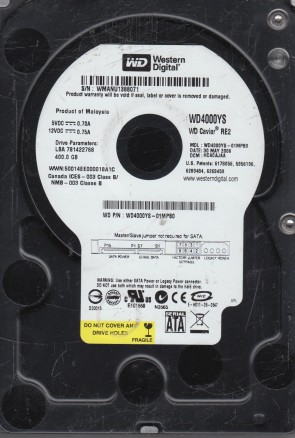
The Western Digital WD4000YS is a 400GB hard disk drive from the enterprise-class RE2 series, designed primarily for RAID environments and high-duty-cycle applications. It utilizes a 3.5-inch form factor, a SATA 3.0 Gb/s interface, and a spindle speed of 7200 RPM. The drive features a 16MB cache buffer and employs perpendicular magnetic recording technology to achieve its storage capacity. Its primary market is small-to-medium business servers, network storage devices, and demanding workstation arrays rather than consumer desktops.
Core specifications include a formatted capacity of 400GB, an average seek time of 8.9 ms read and 10.9 ms write, and a rotational latency of 4.16 ms. The drive supports Native Command Queuing (NCQ) for optimized command execution in multi-threaded workloads. It is built with a dual-processor architecture and a secure-parking head design to enhance reliability. Noise levels are rated at 30 dBA idle and 34 dBA seek, which are moderate for its class but higher than typical consumer drives.
In performance testing, the WD4000YS delivers sequential read speeds around 80-85 MB/s and write speeds near 75-80 MB/s, consistent with other 7200 RPM drives of its generation. Random access performance is respectable, with IOPS (Input/Output Operations Per Second) for 4K random reads averaging 175-200 under typical load. However, the drive struggles with sustained random writes, where performance can drop due to its single-platter design and limited cache. It is not a top performer for heavy database or transactional applications.
Key advantages of the WD4000YS include its robust build quality, a rated lifespan of 1.2 million hours Mean Time Between Failures (MTBF), and enhanced rotational vibration tolerance. This makes it highly durable in multi-drive enclosures and 24/7 operational environments. It also features Time-Limited Error Recovery (TLER), a crucial feature for preventing drive dropouts in RAID arrays, where standard drives may fail to respond during error recovery and cause array degradation.
Disadvantages include lower areal density compared to contemporary drives, resulting in slower sequential transfer rates relative to newer models. The 16MB cache is modest, limiting burst performance in single-user scenarios. Power consumption is also notable, at 8.4W during read/write and 6.9W idle, which is higher than many modern eco-focused drives. Additionally, its acoustic output is audible under load, making it less suitable for quiet home media servers.
Ideal use cases for the WD4000YS include RAID 1 or RAID 5 arrays in file servers, backup systems, and network attached storage (NAS) units where reliability and error management take priority over raw speed. It is also suitable for surveillance systems requiring constant writes. It is not recommended for desktop boot drives, gaming, or single-drive external storage due to its higher noise and power draw compared to consumer alternatives like the WD Caviar SE16 series.
For buyers, the WD4000YS offers a solid choice if you are constructing a legacy server or replacing failed units in an existing RE2 array. Its TLER feature is non-negotiable for many RAID controllers. However, for new builds, modern drives such as the WD Red or WD Gold series provide better performance, lower power use, and larger capacities at similar price points. Always verify compatibility with your RAID controller, as some older controllers may not recognize drives over 2TB, which is not an issue with this 400GB model.
In summary, the Western Digital WD4000YS is a reliable, enterprise-focused hard drive with excellent vibration tolerance and RAID optimization. It excels in environments requiring continuous operation and high fault tolerance but falls short in speed and efficiency compared to more recent designs. Buyers should weigh the need for legacy compatibility against the benefits of newer technology. For mission-critical storage where uptime is paramount, the WD4000YS remains a competent, if dated, option.