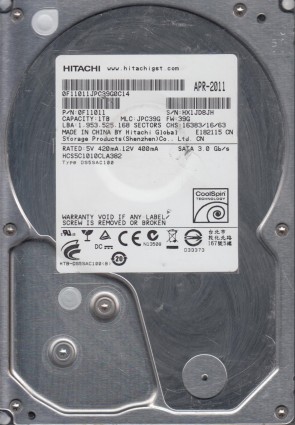
HGST HCS5C1010CLA382 3.5″ hard drive with a storage capacity of 1 TB and featuring a SATA interface. HGST HCS5C1010CLA382 CinemaStar 5C1000 1 TB 3.5″ Internal Hard Drive Serial ATA-300 5400 RPM 32 MB Buffer.
All information about the HGST HCS5C1010CLA382 hard disk drive: technical parameters, failure symptoms, frequently asked questions, reviews, HDD repair and data recovery.

HGST HCS5C1010CLA382 Technical Details:
Note: The HGST HCS5C1010CLA382 is part of the CinemaStar 5C1000 series, specifically designed for consumer electronics (CE) applications such as DVRs, set-top boxes, and media centers. The CinemaStar series was HGST’s answer to the growing demand for reliable, quiet, and power-efficient storage in video recording applications. Key features include CoolSpin technology for reduced power consumption, SilentSeek for quiet operation, and Smart Command Transport for optimized A/V streaming.
HGST HCS5C1010CLA382 Hard Drives:
- HCS5C1010CLA382 – 1 TB SATA 3.5″ Consumer Electronics Hard Drive, CinemaStar 5C1000 series
- Model code breakdown: HCS5C (CinemaStar 5C series) + 1010 (1 TB capacity) + CLA382 (specific model variant)
- Common firmware revisions: GZ1OA980, GZ1OA9A0, GZ1OAA90
- Capacity in LBA: 1,953,525,168 sectors
- Also known as: Hitachi HCS5C1010CLA382 (pre-acquisition branding)
- Recommended usage: DVR/PVR, set-top boxes, media servers, quiet home theater PCs
HGST HCS5C1010CLA382 Failure Symptoms:
Electrical Failure Symptoms:
- Drive is powered, but shows no sign of function;
- Disk knocking as the motor fails to spin;
- Clicking sound as the heads search or initialize;
- Burnt components on PCB – particularly TVS diodes or the motor controller IC.
Mechanical Failure Symptoms:
- Clicking, grinding sounds (head/media damage);
- Completely quiet due to “motor freeze” (bearing seizure);
- Drive spins but produces rhythmic clicking – typical of head failure;
- Occasional “scraping” sound indicating platter damage;
- High-pitched whine indicating spindle motor issues.
Logical Failure Examples:
- Accidental deletion, accidental format, file corruption, software bugs;
- File system corruption, viruses and malware;
- Partition table loss or MBR/GPT corruption;
- “SMART” failure warnings from BIOS or DVR;
- Recorded video playback showing artifacts or skipping.
Firmware Failure Symptoms:
- Drive powers up but is not recognised by the computer/DVR;
- Drive powers up but is recognised wrongly, sometimes with nonsensical characters;
- Drive freezes during booting up;
- Drive detected with 0 MB capacity (service area corruption);
- SMART attributes showing unusual values (e.g., 65535 or 0);
- DVR fails to record or playback despite drive spinning.
Bad Platter Area Symptoms:
- Hard disk still accessible but appears to “hang” or be “sluggish”;
- Constant Cyclic Redundancy Check (CRC) errors;
- Unable to access folders or files which could be seen;
- Gradual increase of reallocated sector count in SMART data;
- Pending sector count increasing over time;
- Video recording fails with “write error” messages.
Complex Failure Model
(A combination of two or more of the above failure types)
HGST HCS5C1010CLA382 Data Recovery & HDD Repair:
When it comes to data recovery, one of the most common problems the HGST HCS5C1010CLA382 hard drive experiences is PCB (circuit board) failure due to power surges, followed by firmware corruption and head failure. Like other HGST/Hitachi drives of this era, this model has a separate ROM/NVRAM chip that stores drive-specific adaptation data.
PCB Replacement Information:
To replace a faulty PCB on a HGST HCS5C1010CLA382, you need to match the following:
- Model number: HCS5C1010CLA382
- PCB part number: Common numbers include 0A32870, 0A32871, G0130B
- Main controller IC number: Often 88i9146 or similar (Marvell)
- Firmware revision: e.g., GZ1OA980, GZ1OA9A0, GZ1OAA90
⚠️ Critical Note: The HGST HCS5C1010CLA382 has a separate ROM/NVRAM chip (usually 25P10VP or similar) on the PCB. This chip stores drive-specific calibration and adaptive data including head maps and zone allocation tables. When replacing the PCB, you MUST transfer the original ROM chip from the old PCB to the new donor board, or use a programmer to copy the ROM contents. Without this, the drive will not function correctly and may not be detected at all.
Symptom Analysis Based on User Reports:
Repair & Data Recovery Options by Failure Type:
Comparison with Related HGST Models:
Frequently Asked Questions (FAQs):
Q: Is the HGST HCS5C1010CLA382 a 3.5″ or 2.5″ drive?
A: It is a 3.5-inch consumer electronics hard drive.
Q: What is the capacity of the HCS5C1010CLA382?
A: 1 TB (1,000,000,000,000 bytes). The formatted capacity is approximately 931.5 GB.
Q: What is the RPM and cache size?
A: 5400 RPM (CoolSpin technology) and 32 MB cache.
Q: What interface does the HCS5C1010CLA382 use?
A: Serial ATA (SATA) with SATA-300 (3 Gb/s) support.
Q: What is the CinemaStar 5C series?
A: The CinemaStar 5C series was HGST’s consumer electronics hard drive line, specifically designed for DVRs, set-top boxes, and media center applications. Key optimizations included:
– CoolSpin – reduced power consumption and heat
– SilentSeek – quieter seek acoustics
– Smart Command Transport – optimized command handling for A/V streaming
– Temperature Sensor Fly Height Monitor – improved reliability in enclosed CE devices
Q: What does the model number HCS5C1010CLA382 mean?
A: The model number breaks down as:
– HCS5C = CinemaStar 5C series
– 1010 = 1 TB capacity (10 = 1000 GB, plus identifier)
– CLA382 = Specific model variant (interface/form factor identifier)
Q: Can I use this drive as a regular desktop drive?
A: Yes, the HCS5C1010CLA382 can be used as a standard desktop drive. However, its firmware is optimized for streaming media (sequential writes) rather than random access. For general desktop use, the Deskstar series (7200 RPM) would provide better performance. That said, the CinemaStar drives work perfectly as data storage drives in media PCs or as secondary drives.
Q: My drive is dead and doesn’t spin. Can I replace the PCB myself?
A: Yes, but with important caveats. You need a donor PCB with:
– Identical model number (HCS5C1010CLA382)
– Identical PCB part number (e.g., 0A32870, 0A32871, G0130B)
– Similar firmware revision
You MUST transfer the original ROM chip (usually an 8-pin IC labeled 25P10VP) from the old PCB to the new donor board, or copy its contents using a programmer. Without this, the drive will not work correctly.
Q: My HCS5C1010CLA382 clicks rhythmically and is not detected. What’s wrong?
A: Rhythmic clicking (usually 5-10 clicks followed by motor stop) is a classic symptom of head failure. The heads cannot read the servo tracks or firmware from the platters. This requires a cleanroom head swap performed by a professional data recovery service.
Q: Can I recover data from a HCS5C1010CLA382 with bad sectors?
A: Yes, you can try using ddrescue on Linux to create a disk image, skipping bad sectors. However, if the drive has physical damage (clicking, grinding), do not run ddrescue – seek professional help immediately. For CinemaStar drives, it’s worth noting that bad sectors often appear in areas where DVR recordings were repeatedly overwritten.
Q: What is CoolSpin technology?
A: CoolSpin is HGST’s technology that optimizes the drive for lower power consumption and cooler operation. It allows the drive to run at 5400 RPM while maintaining reliability, making it ideal for enclosed consumer electronics devices where heat dissipation is limited.
Q: Is the HCS5C1010CLA382 compatible with modern operating systems?
A: Yes, the drive is compatible with all major operating systems including Windows, Linux, and macOS. The SATA interface is backward compatible with SATA 6 Gb/s ports. However, as a 5400 RPM drive, it is significantly slower than modern SSDs. It works well as a storage drive but not recommended as a boot drive for modern OSes.
Q: What is the power consumption of this drive?
A: The HCS5C1010CLA382 typically consumes:
– Read/Write: ~4.5 W
– Idle: ~3.0 W
– Standby/Sleep: ~0.5 W
These low power figures are a result of the CoolSpin technology.
Q: Is this drive worth buying today?
A: For new builds, no – modern SSDs or larger capacity HDDs are better options. However, for legacy DVR repair or retro media center builds, a used HCS5C1010CLA382 can be a cost-effective replacement. Used units should be tested thoroughly with SMART diagnostics before deployment. Check power-on hours and reallocated sector count – drives with more than 30,000 hours or any reallocated sectors should be avoided for critical recordings.
User Reviews & Summary:
Pros:
– Designed for 24/7 CE operation (DVR/PVR)
– 1,000,000 hour MTBF – excellent reliability
– CoolSpin technology – low power consumption and heat
– SilentSeek – quiet operation suitable for living rooms
– Smart Command Transport – optimized for A/V streaming
– 32 MB cache – adequate for media streaming
– HGST/Hitachi build quality – known for reliability
Cons:
– 5400 RPM – slower than 7200 RPM drives
– SATA 3 Gb/s – limited by modern standards
– 1 TB capacity is small by today’s standards
– Not optimized for random read/write workloads
– Discontinued – only available used/refurbished
– Requires 4K sector alignment for older OS
Final Verdict:
The HGST HCS5C1010CLA382 (CinemaStar 5C1000 series, 1 TB) is a consumer electronics-optimized hard drive designed for DVRs, set-top boxes, and home media centers. Released in the late 2000s, it represented HGST’s answer to the growing digital video recording market, offering features like CoolSpin for low power, SilentSeek for quiet operation, and Smart Command Transport for optimized A/V streaming.
Key differentiators of the CinemaStar series include:
– Enhanced thermal management – drives can operate reliably in enclosed CE devices
– Optimized A/V command set – better streaming performance
– Lower acoustics – suitable for home theater environments
– 24/7 operation support – designed for always-on DVRs
If you still have a working HCS5C1010CLA382 today, it remains a capable drive for:
– Legacy DVR/PVR repairs or replacements
– Retro media center builds
– Secondary storage in quiet PC builds
– External USB enclosures for backup
However, never store irreplaceable data on any aging mechanical drive without backups.
For data recovery from a failed CinemaStar drive, professional assistance is strongly recommended, especially if the drive was used in a DVR as recordings may be stored in non-standard file systems that consumer recovery tools struggle with.
Pro Data Recovery Tip: If your HCS5C1010CLA382 is from a DVR, the file system is often a proprietary format (like XTV or FAT32 with large sectors). Standard recovery tools may not recognize the partition structure. In such cases, a professional service with DVR-specific recovery expertise is recommended. Additionally, do not attempt to rebuild the partition table or run CHKDSK on DVR drives – this often destroys the video index and makes full recovery impossible.