Reviews of the Western Digital WD20EARS Hard Drive. Western Digital WD20EARS—a storage device that belongs to a specific era and occupies a distinct position in the market. Whether this is a brand-new mainstream drive or a decades-old retro component, our goal remains the same: to evaluate it fairly within its intended context. We will examine its physical specifications, interface compatibility, real-world transfer performance, acoustic behavior, thermal output, and long-term reliability considerations.
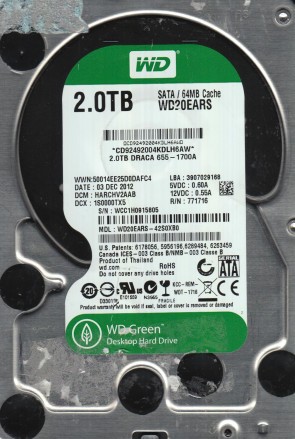
The Western Digital WD20EARS is a 2TB internal hard drive from the Caviar Green series, designed primarily for eco-conscious consumers and bulk storage applications. It operates at a fixed 5400 RPM spindle speed and utilizes Advanced Format (4K sectors) technology to increase areal density and reduce power consumption. The drive comes with a 64MB cache and a SATA 3.0Gb/s interface, positioning it as a cost-effective solution for secondary storage rather than high-performance computing.
Core specifications include a formatted capacity of 2,000,398 MB, an average latency of 5.5 ms, and a typical operating power draw of just 5.4 Watts under read/write loads. The idle power consumption drops to approximately 4.0 Watts, and the drive features Western Digital’s IntelliSeek and IntelliPark technologies to optimize seek times and reduce head wear during inactive periods. The physical dimensions are standard 3.5-inch form factor, weighing about 690 grams.
In terms of performance, the WD20EARS delivers sequential read and write speeds averaging around 80-90 MB/s for large files, which is moderate for its class. Random access performance is notably lower, with 4K random write speeds often falling below 1 MB/s due to the 4K sector alignment requirements and the inherently slower spindle speed. This drive is not suited for operating system boot duties or heavy multi-tasking environments where quick random I/O is critical.
The primary advantage of the WD20EARS is its exceptional energy efficiency and low heat output, making it ideal for always-on systems like network-attached storage (NAS) boxes or external enclosures where power savings over time matter. It also operates very quietly, with typical noise levels around 25 dBA, which is barely audible in a quiet room. However, a significant drawback is its poor random write performance, which can cause noticeable slowdowns when used for general-purpose computing or database applications.
Another notable weakness is the need for proper alignment when used with older operating systems (pre-Windows Vista or non-aligned partitioning tools), as misaligned partitions can severely degrade performance. The drive also lacks advanced reliability features like dual-stage actuator or shock sensors found in enterprise models, so it is not recommended for mission-critical server environments. Additionally, its warranty period is typically only 2-3 years, reflecting its consumer-grade design.
The ideal use cases for the WD20EARS include bulk media storage, backup drives, low-power file servers, and archival storage for documents or photos where write frequency is low. It functions well in external USB enclosures for laptops or as a secondary internal drive for storing large libraries of movies, music, or software. Users building a high-capacity, low-power home server with moderate read demands will find it a balanced choice.
For purchasing decisions, this drive is best bought as a second-hand or clearance item due to its age and the availability of newer, faster models. If absolute low power and quiet operation are the top priorities, and the workload is predominantly sequential reads, it can still be a viable option. However, for any modern system requiring responsiveness or random access, buyers should consider Western Digital’s Blue or Black series, or an SSD, as the WD20EARS is no longer competitive for primary storage tasks.