Reviews of the Western Digital WD15NPVX Hard Drive. Western Digital WD15NPVX—a storage device that belongs to a specific era and occupies a distinct position in the market. Whether this is a brand-new mainstream drive or a decades-old retro component, our goal remains the same: to evaluate it fairly within its intended context. We will examine its physical specifications, interface compatibility, real-world transfer performance, acoustic behavior, thermal output, and long-term reliability considerations.
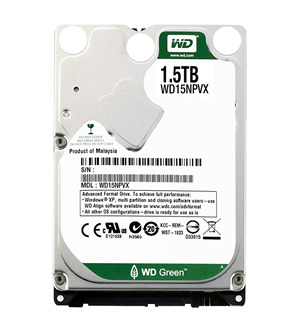
The Western Digital WD15NPVX is a 1.5TB 2.5-inch internal hard drive designed primarily for use in laptops, portable external enclosures, and other compact storage applications. As part of WD’s mainstream Blue series, it targets users who need a reliable, high-capacity storage solution without the premium cost of solid-state drives or high-performance enterprise HDDs.
Core specifications include a 5400 RPM spindle speed, a 2.5-inch form factor, a SATA 3.0 interface (6 Gb/s), and a 16 MB cache buffer. The drive utilizes conventional perpendicular magnetic recording technology and features a standard 9.5mm z-height, ensuring compatibility with most laptop bays and external drive cases that accept full-size 2.5-inch drives.
In terms of performance, the WD15NPVX delivers sequential read speeds of around 100-120 MB/s and write speeds in the range of 80-100 MB/s under ideal conditions. Random access times typically fall between 12-15 ms, which is expected for a 5400 RPM drive. It is not designed for heavy multitasking or frequent random I/O operations, as its throughput is limited compared to 7200 RPM drives or SSDs.
Key advantages of this model include its low power consumption (under 2 watts during active use), quiet operation due to the slower spindle speed, and a robust build quality common to WD products. It also runs relatively cool, making it suitable for thermally constrained environments like slim laptops. The primary drawback is its modest performance, which may feel sluggish for operating system booting or application loading when compared to even entry-level SSDs.
Another notable limitation is the absence of advanced features such as hardware encryption or CMR/ SMR confusion; this drive commonly uses SMR (Shingled Magnetic Recording) technology, which can degrade sustained write performance during large file transfers or RAID rebuilds. Additionally, its 1.5TB capacity, while generous at launch, now faces competition from larger and faster alternatives at similar price points.
This hard drive is best suited for secondary storage in laptops—such as mass storage for media files, documents, or backups—as well as for external USB enclosures where cost per gigabyte matters more than speed. It is not recommended for a primary OS drive, gaming workstations, or server applications that require consistent high-speed access or 24/7 operation.
For purchase consideration, the WD15NPVX offers a reasonable cost per terabyte for bulk storage, but buyers should confirm the exact model variant to avoid SMR-related issues if they plan to use it in RAID arrays. Given its age in the market, checking for warranty status and refurbished availability is advisable. Most consumers today would be better served by a small SSD for the boot drive paired with this HDD for storage, rather than using it as a standalone system disk.