Reviews of the Seagate ST160LT016 Hard Drive. Seagate ST160LT016—a storage device that belongs to a specific era and occupies a distinct position in the market. Whether this is a brand-new mainstream drive or a decades-old retro component, our goal remains the same: to evaluate it fairly within its intended context. We will examine its physical specifications, interface compatibility, real-world transfer performance, acoustic behavior, thermal output, and long-term reliability considerations.
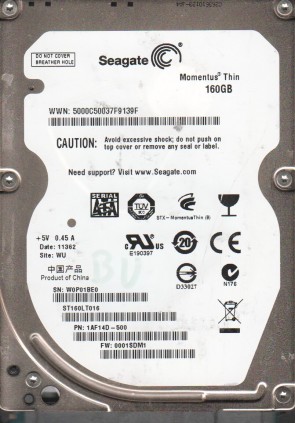
The Seagate ST160LT016 is a 2.5-inch internal hard disk drive designed for mainstream laptop storage and external enclosure applications, offering a balance of capacity and cost-efficiency at the entry level. It targets users who require a reliable mechanical drive for large file storage, such as media libraries or game archives, rather than high-speed operating system duties. This model utilizes a traditional spinning platter technology with a 5400 RPM spindle speed, positioning it as a standard storage companion rather than a high-performance component. Its slim 7mm form factor ensures broad compatibility with ultrabook-type laptops and portable drive cases.
Core specifications include a formatted capacity of 160 GB, which is modest by modern standards, a SATA 3.0 Gb/s interface for backward compatibility with older systems, and a 16 MB cache buffer that aids in small file handling. The drive features a single-platter construction, which contributes to its low power consumption and quiet operation, drawing approximately 1.3 watts during read/write tasks. Its physical dimensions are 100.35 x 69.85 x 7.0 mm, and it weighs under 100 grams, making it one of the lighter 2.5-inch HDDs available.
In terms of performance, the ST160LT016 delivers sequential read speeds averaging around 85 MB/s and write speeds of approximately 80 MB/s under ideal conditions, with access times near 15 milliseconds. Random read and write operations are significantly slower due to the mechanical nature of the device, typically achieving less than 1 MB/s in 4K random workloads. These figures are typical for a 5400 RPM 160 GB drive, but they cannot match modern SSHDs or SSDs in responsiveness. The drive’s performance is adequate for sequential tasks like copying large video files but becomes a bottleneck in multitasking or boot-only scenarios.
A key advantage of this model is its reliability track record, with Seagate specifying a 0.9% annualized failure rate based on datacenter testing, along with a load/unload cycle rating of 300,000 cycles. It operates silently, with an acoustic output of 2.2 dB during idle and 2.3 dB during seek, and it remains cool due to low power dissipation. However, its major drawback is limited capacity: 160 GB fills quickly with modern operating systems, software, and media, forcing users to manage space frequently. Additionally, the 5400 RPM speed makes it unsuitable for running demanding applications or modern games with heavy asset streaming.
Ideal use cases include use as a secondary storage drive in an older laptop that already has a primary SSD, for archival purposes in external USB enclosures where speed is less critical, or in legacy devices requiring a drop-in replacement for a failed factory drive. It works well for storing documents, music, and images, or as a backup drive for non-time-sensitive data. It is not recommended as a primary drive in any current system where operating system responsiveness is valued, nor for video editing work because of slow random access.
When considering a purchase, the ST160LT016 is only viable if the price is exceptionally low and the user has modest storage needs that do not exceed 160 GB. In most cases, a higher-capacity 500 GB or 1 TB 2.5-inch HDD from the same generation offers far better value per gigabyte without significant cost increase. Alternatively, a 120 GB or 240 GB 2.5-inch SATA SSD provides far superior performance for daily use at a slightly higher price point, making the ST160LT016 a niche product suitable mainly for refurbishing very old netbooks or as a cheap replacement for dead drives in budget-conscious builds. Buyers should verify interface compatibility, especially for SATA 1.5 Gb/s systems, as the drive is natively SATA 3.0 and may require jumper settings.