Reviews of the Seagate ST973451SS Hard Drive. Seagate ST973451SS—a storage device that belongs to a specific era and occupies a distinct position in the market. Whether this is a brand-new mainstream drive or a decades-old retro component, our goal remains the same: to evaluate it fairly within its intended context. We will examine its physical specifications, interface compatibility, real-world transfer performance, acoustic behavior, thermal output, and long-term reliability considerations.
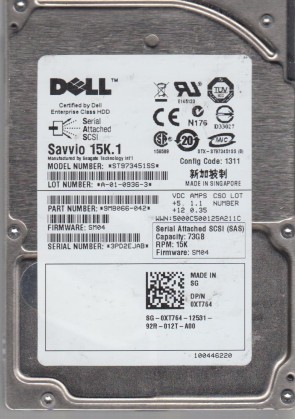
The Seagate ST973451SS is a 2.5-inch enterprise-grade hard disk drive designed for high-performance server and storage array environments. It features a SAS (Serial Attached SCSI) 6Gb/s interface, a spindle speed of 10,000 RPM, and a formatted capacity of 73.4 GB. This drive utilizes a conventional platter-based magnetic recording technology, targeting applications where reliability and consistent I/O throughput are prioritized over raw storage density.
Core specifications include a 16 MB cache buffer, an average latency of 3.0 ms, and a sustained data transfer rate of up to 135 MB/s. The drive operates at 5V and 12V power inputs, with a typical power consumption of around 5.5 watts during read/write operations and 4.0 watts at idle. It is built with a standard 2.5-inch form factor, making it compatible with most enterprise server bays and hot-swap cages designed for SAS drives.
In terms of performance, the ST973451SS delivers solid random read and write IOPS for its generation, typically achieving around 130–150 random I/O operations per second at queue depth 1. Sequential throughput remains consistent under sustained load, though it is significantly lower than modern SSDs or larger-capacity enterprise HDDs. The drive’s seek time averages 4.2 ms for reads and 5.0 ms for writes, which is competitive for a 10K RPM HDD but not exceptional by current standards.
Key advantages include excellent reliability ratings, with a mean time between failures (MTBF) of 1.6 million hours, and a robust rotational vibration tolerance suitable for multi-drive enclosures. Its enterprise SAS interface provides full-duplex data transfers, command queuing, and error recovery features not available in consumer SATA drives. However, notable drawbacks include low capacity (73 GB), high power draw relative to modern 2.5-inch drives, and significantly slower performance compared to even entry-level SSDs.
This drive is best suited for legacy server upgrades, RAID arrays in archival or secondary storage roles, or applications requiring high spindle-speed SAS drives for compatibility with older controller hardware. It is not recommended for primary operating system drives, high-frequency database transactions, or any workload where low latency or large capacity is critical. The ST973451SS is also a poor choice for modern virtualization hosts or real-time analytics platforms.
For prospective buyers, consider this drive only if you have a specific need for a small-capacity SAS HDD with proven long-term reliability, or if you are maintaining an existing infrastructure that mandates identical drive replacements. Given its age and technological limitations, purchasing used or refurbished units may be economical for non-critical applications, but newer SAS SSDs or high-capacity HDDs offer far better value for most current use cases. Always verify compatibility with your host controller and backplane before integration.