Reviews of the Seagate ST3320620AS Hard Drive. Seagate ST3320620AS—a storage device that belongs to a specific era and occupies a distinct position in the market. Whether this is a brand-new mainstream drive or a decades-old retro component, our goal remains the same: to evaluate it fairly within its intended context. We will examine its physical specifications, interface compatibility, real-world transfer performance, acoustic behavior, thermal output, and long-term reliability considerations.
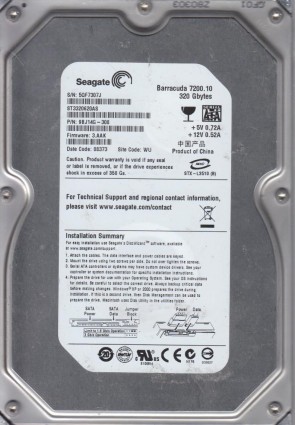
The Seagate ST3320620AS is a 320GB 3.5-inch internal hard disk drive from the Barracuda 7200.10 series, positioned as a mainstream storage solution for desktop computers during its production era. It utilizes a SATA 3.0Gb/s interface with a 16MB cache buffer, and spins at 7200 RPM, aiming to balance capacity, speed, and affordability for everyday computing tasks.
Core specifications include a formatted capacity of 320GB, an average latency of 4.16ms, and a seek time typically rated at 8.5ms read / 9.5ms write. The drive features perpendicular recording technology, which was a notable advancement at its launch, allowing higher areal density compared to older longitudinal designs. Its form factor is standard for desktop PC bays.
In terms of performance, the ST3320620AS delivers sequential read and write speeds around 75-85 MB/s for outer tracks, with inner track speeds dropping to approximately 45-55 MB/s, resulting in an average sustained transfer rate near 65-70 MB/s. Random access times are competitive for a 7200 RPM HDD of its generation, typically scoring between 14-17ms under typical workloads. It is not designed for NVMe or SSD-level low latency.
Advantages of this drive include reliable long-term operation in many user reports, decent sequential throughput for its era, and compatibility with older motherboards that lack advanced SATA features. The 320GB capacity was ample for OS installations and moderate file storage. Noise levels are moderate, with idle acoustics around 2.7 bel and seek noise slightly higher, but generally acceptable for a desktop environment.
Disadvantages are significant by modern standards. The 320GB capacity is very small compared to contemporary multi-terabyte drives, and the mechanical design inherently suffers from higher latency, lower random I/O, and vulnerability to physical shock. Power consumption is modest at around 8-10W during read/write, but it cannot compete with modern SSDs in speed, efficiency, or reliability in drop-prone usage.
Ideal use cases include legacy system upgrades where a 2.5-inch or NVMe SSD is incompatible or cost-prohibitive, secondary storage for archived data that does not require fast random access, or as a replacement for a failed drive in a very old desktop. It is not suitable for modern operating system boot drives or any workload requiring rapid application loading or frequent small file access.
Purchasing this drive new is not recommended because it is a discontinued legacy product; any units sold are likely old stock or used. For budget-conscious users, a new 1TB or larger SATA SSD provides massively better performance and reliability for a small price premium. If compatibility with an old system is the only concern, ensure the motherboard supports 3.0Gb/s SATA, but a used unit should be tested thoroughly for bad sectors before relying on it.