Reviews of the Samsung HD103UI Hard Drive. Samsung HD103UI—a storage device that belongs to a specific era and occupies a distinct position in the market. Whether this is a brand-new mainstream drive or a decades-old retro component, our goal remains the same: to evaluate it fairly within its intended context. We will examine its physical specifications, interface compatibility, real-world transfer performance, acoustic behavior, thermal output, and long-term reliability considerations.
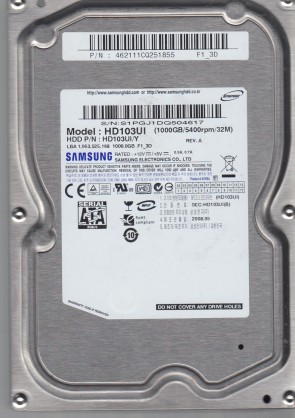
The Samsung HD103UI is a 1TB 3.5-inch internal hard drive designed for desktop storage expansion, utilizing a 5400 RPM spindle speed and a SATA 3Gbps interface. It is positioned as a cost-effective solution for bulk data storage rather than high-speed system drives, featuring a single-platter design that keeps power consumption low at around 5.4 watts during operation.
Core specifications include a 32MB cache buffer, an average seek time of 8.9 ms, and a sustained data transfer rate of up to 130 MB/s. The drive supports Advanced Format (4K sectors) for improved efficiency with large file writes, and it incorporates Samsung’s SilentSeek and NoiseGuard technologies to minimize acoustic noise during seeking and idle states.
In performance tests, the HD103UI delivers sequential read and write speeds approximately 110-125 MB/s, which is expected for its 5400 RPM class. Random access latency hovers around 12-15 ms, making it adequate for archival tasks but noticeably slower than 7200 RPM drives in multitasking scenarios. Thermal output remains moderate, typically staying below 30°C under continuous load in well-ventilated cases.
The primary advantages of this drive are its low price per gigabyte, quiet operation (idle noise around 24 dBA), and energy efficiency. It also benefits from a slim profile due to the single-platter layout, reducing weight and heat generation. However, its 5400 RPM speed limits write-intensive workloads, and the lack of a 7200 RPM variant means it is not suitable for operating system installation or gaming.
Disadvantages include relatively poor performance for frequent small-file writes, and the drive may exhibit slower boot times if used as a primary OS disk. Additionally, the 3Gbps SATA interface, while compatible with modern systems, does not leverage the full bandwidth of newer SATA 6Gbps connections, though this is rarely a bottleneck for sequential transfers at this rotational speed.
This drive is best suited for external enclosures, network-attached storage (NAS), media libraries, backup archives, or secondary storage for documents and photos. It is not recommended for video editing workloads or as a system disk where responsiveness is critical. Users should also ensure their operating system supports Advanced Format 4K sectors to avoid alignment-induced slowdowns.
For purchase decisions, the HD103UI offers excellent value for non-performance-sensitive storage needs. Buyers seeking higher random read/write speeds should consider the Samsung HD103UJ (a 7200 RPM version) or modern SSDs for system duties. Check compatibility with existing hardware, especially if using older controllers, and verify that the drive has not been exposed to excessive shock during shipping to avoid premature failures.