Reviews of the Toshiba MK1265GSX Hard Drive. Toshiba MK1265GSX—a storage device that belongs to a specific era and occupies a distinct position in the market. Whether this is a brand-new mainstream drive or a decades-old retro component, our goal remains the same: to evaluate it fairly within its intended context. We will examine its physical specifications, interface compatibility, real-world transfer performance, acoustic behavior, thermal output, and long-term reliability considerations.
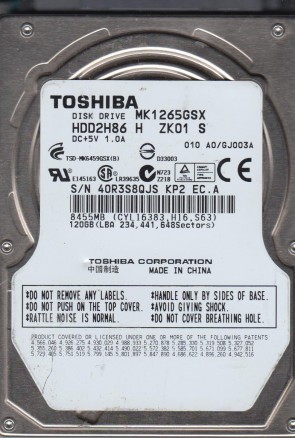
The Toshiba MK1265GSX is a 2.5-inch internal hard disk drive designed primarily for mainstream laptop computers and external storage enclosures. It was a popular choice during its production era, offering a balance between capacity and cost for everyday computing tasks. This SATA drive operates at a standard 5400 RPM spindle speed.
Core specifications include a 120 GB storage capacity, a 5400 RPM rotational speed, and an 8 MB cache buffer. It utilizes a SATA 3.0 Gbps interface. The drive features a compact form factor with a height of 9.5 mm, making it compatible with most standard laptop bays of its time. Power consumption is rated at a typical 1.5 watts during read/write operations.
In terms of performance, the MK1265GSX delivers sequential read and write speeds in the range of 60 to 70 MB/s. Random access times hover around 12 to 15 milliseconds, which is typical for a 5400 RPM notebook drive. It is not designed for high-performance tasks but provides adequate speed for booting an operating system, loading applications, and transferring files.
A key advantage of this drive is its low power consumption and relatively quiet operation, making it suitable for battery-powered laptops. It also demonstrates reliable mechanical stability during light movement. However, its main drawback is the limited 120 GB capacity, which is insufficient for modern software collections, large media libraries, or intensive multitasking.
The drive is also susceptible to performance degradation under heavy random I/O workloads, such as running multiple virtual machines or database queries. The older SATA interface further limits maximum throughput compared to modern SATA III drives or solid-state drives. Noise and vibration levels are below average but audible in silent environments.
Ideal use cases include secondary storage for an older laptop, a budget-friendly upgrade for a netbook, or as a storage component in a standalone external hard drive for backups. It is not recommended for modern operating systems, high-definition video editing, or gaming applications due to its capacity and speed constraints.
For buyers considering this drive, it is best sourced as a new old stock item for very low-cost projects. At current market prices, a used SSD of equal capacity offers significantly better performance and reliability. Purchase only if the specific 120 GB form factor or extremely low power draw is a strict requirement for a legacy system.