HGST HUS153014VL3800 3.5″ hard drive with a storage capacity of 147GB and featuring a SCSI interface.
All information about the HGST HUS153014VL3800 hard disk drive: technical parameters, failure symptoms, HDD PCB repair and recommended retailers.
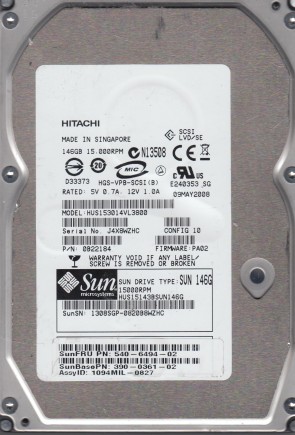
HGST HUS153014VL3800 Technical Details:
Manufacturer:
HGST (Hitachi Global Storage Technologies)
Hard Disk Model:
HUS153014VL3800
Disk Family:
Ultrastar 15K300
Form Factor:
3.5″
Capacity:
147 GB (147,000,000,000 bytes)
Formatted Capacity:
Approximately 137 GB
Rotational Speed:
15000 RPM (15K)
Average Seek Time:
3.4 ms (read) / 3.8 ms (write)
Disk Interface:
SCSI
Buffer Size:
16384 KB (16 MB)
External Transfer Rate:
400 MB/s (4 Gb/s FC)
Mean Time Between Failures (MTBF):
1,400,000 hours
HGST HUS153014VL3800 Hard Drives:
- HUS153014VL3800 HITACHI ULTRA STAR 15K300 147GB 15000RPM ULTRA-320 80-PIN 3.5INCH SCSI HARD DRIVE
HGST HUS153014VL3800 Failure Symptoms:
- Electrical Failure Symptoms:
Drive is powered, but shows no sign of function;
Disk knocking as the motor fails to spin;
Clicking sound as the heads search or initialize; - Mechanical Failure Symptoms:
Clicking, grinding sounds;
Completely quiet due to “motor freeze”;
“music” tone as the disk is powered up; - Logical Failure Examples:
Accidental deletion, accidental format, file corruption, software bugs, file system corruption, viruses and malware, and many, many more. - Firmware Failure Symptoms:
drive powers up, but is not recognised by the computer;
Drive powers up, but is recognised wrongly, sometimes with nonsensical characters;
Drive freezes during booting up; - Bad Platter Area Symptoms:
Hard disk still accessible but appear to “hang” or “sluggish”;
Constant Cyclic Redundancy (CRC) errors;
Unable to access folders or files which could be seen; - Complex Failure Model
HGST HUS153014VL3800 HDD PCB Repair:
When it comes to data recovery one of the most common problems HGST HUS153014VL3800 hard drive experience is a burned circuit board (PCB). Therefore, if you need to replace the PCB, be sure to match the “PCB Number” of the current board, such as 0B22485, etc.